Category: In Practice

  • The Law Came Into Force 54 Days Before the Full-Scale Invasion

    The Law Came Into Force 54 Days Before the Full-Scale Invasion

    Members of Ukraine's Parliament applauding during the vote on the inland water transport law, 3 December 2020
    Ukraine’s Parliament votes on draft law No. 1182-1-д, 3 December 2020. Screenshot: Rada TV

    On 1 January 2022, Ukraine’s Law on Inland Water Transport came into force. Fifty-four days later, Russia launched its full-scale invasion.

    I knew that law unusually well. Not because I am a lawyer or an expert in shipping, but because I had spent much of the previous two years working with the people trying to make the reform happen.

    At a glance

    The Challenge: Repeated unsuccessful legislative attempts and competing interests in Ukraine’s inland waterway sector.

    The Approach: A year-long strategy combining stakeholder engagement, advocacy and multimedia outreach to help advance the reform.

    The Result: Ukraine’s Parliament adopted the Law on Inland Water Transport in December 2020. The law entered into force in January 2022.

    Before the vote

    When I joined EU Assistance for Dnipro Transport Development in 2019 as its communication and stakeholder engagement expert, Ukraine had been trying to modernise its inland waterway legislation for years.

    Transport operators, businesses and policymakers disagreed about how the sector should function, who should pay for maintaining the waterways and what greater competition would mean. These were genuine disagreements, not problems a clever slogan could solve.

    A decade of unsuccessful attempts made me realise that another campaign explaining the proposed law would not be enough. I proposed a year-long communications and advocacy strategy built around sustained dialogue with the institutions involved in the reform and the public it was intended to serve.

    Too often, communications is brought in to announce a decision once the difficult discussions are over. I wanted it involved while those discussions were still taking place.

    Once the key stakeholders backed my approach, we organised consultations and roundtables with parliamentarians, engaged government institutions, business associations, civil society and journalists, and produced interviews, videos, infographics and opinion pieces to explain the reform to wider audiences. We also conducted vox pops with citizens to understand how they perceived the reform and whether they recognised its potential benefits.

    Stakeholder consultation on inland water transport reform, 2019
    Stakeholder consultation, 2019. Photo: EU Assistance for Dnipro Transport Development
    Minister of Infrastructure Vladyslav Kryklii and Yurii Kisel, Chair of the Parliamentary Committee on Transport and Infrastructure, September 2019
    Minister of Infrastructure Vladyslav Kryklii and Yurii Kisel, Chair of the Parliamentary Committee on Transport and Infrastructure, discussing the reform, September 2019. Photo: EU Assistance for Dnipro Transport Development
    Ramona Lupu with Deputy Minister of Infrastructure Yurii Vaskov filming an interview by the Dnipro in Kyiv
    With Yurii Vaskov, Ukraine’s Deputy Minister of Infrastructure at the time, filming an interview about inland waterway transport reform by the Dnipro in Kyiv. Photo: delo.ua

    This was stakeholder engagement and advocacy embedded in the reform process — not publicity after the fact.

    On 3 December 2020, after a decade of legislative attempts, Ukraine’s Parliament finally adopted the Law on Inland Water Transport.

    In November 2021, I published an opinion piece in NV Ukraine about the environmental and economic potential of river transport and Ukraine’s closer integration with Europe.

    I was writing about greener transport, trade and long-term development. Three months later, those priorities were overtaken by Russia’s full-scale invasion.

    Navigation on the Dnipro was severely disrupted, while Ukraine’s Danube ports became vital alternative trade routes. Yet the law remained in force, and work on its implementation continued.

    Having spent several years working on EU-supported transport reforms in Ukraine — from road safety and infrastructure project cycle management to the National Transport Master Plan and inland waterways — I came to know the people behind these efforts: government officials, parliamentarians, businesses and civil society representatives.

    I have seen their determination first-hand. And I believe that, with continued support from the EU and other international partners, they will rebuild and modernise Ukraine’s transport sector.
  • The Things We Do for a Launch

    The Things We Do for a Launch

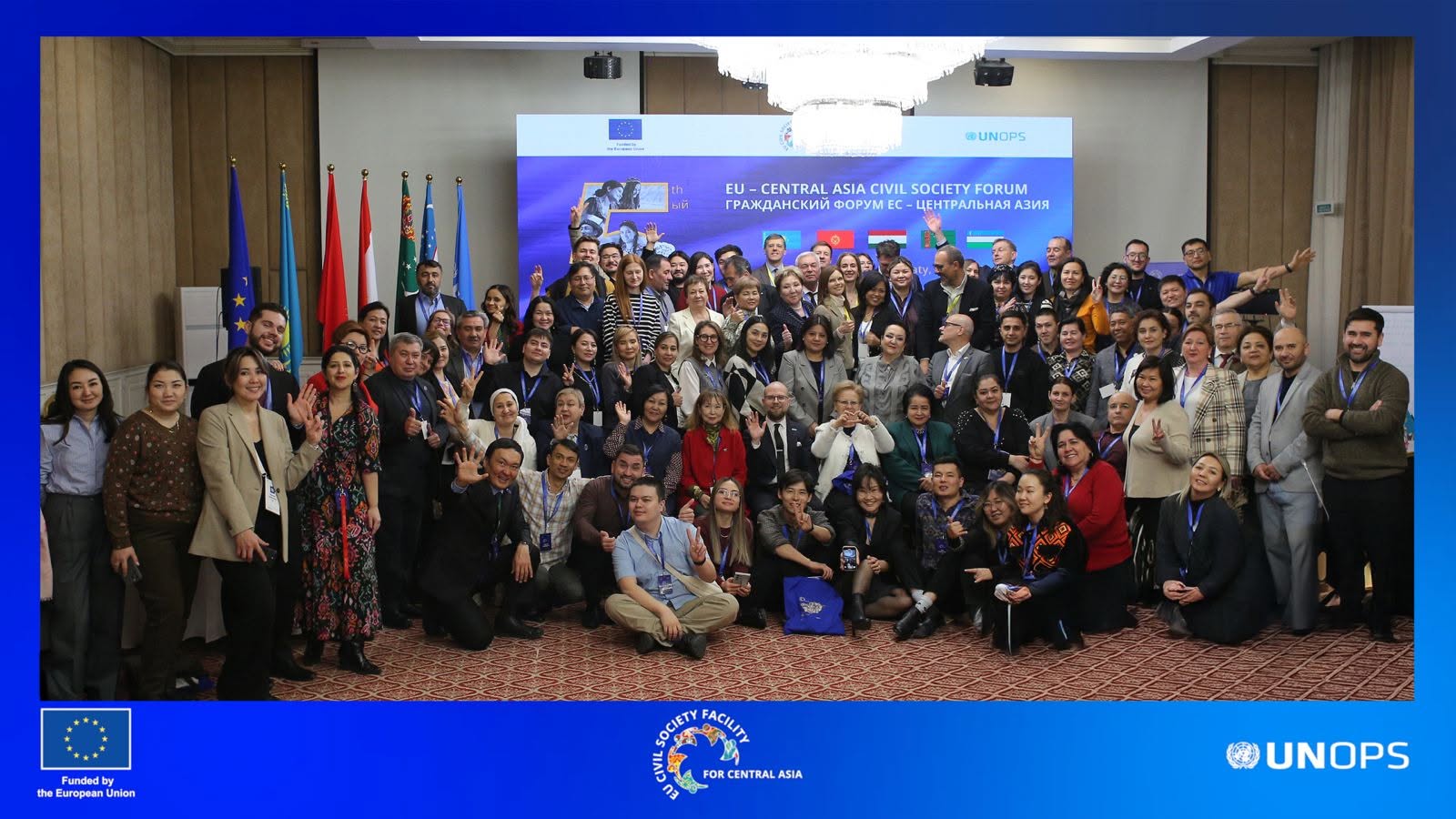
    Fifth EU–Central Asia Civil Society Forum in Almaty, January 2025
    Fifth EU–Central Asia Civil Society Forum, Almaty, January 2025. Photo: EU Civil Society Facility for Central Asia

    It was December 2024. UNOPS was preparing to launch the EU Civil Society Facility for Central Asia, a programme covering five countries, alongside the fifth EU–Central Asia Civil Society Forum. The event was scheduled for late January in Almaty, bringing together civil society, governments, EU officials and international development partners.

    There was plenty to organise. And not a great deal of time.

    In Astana, I met colleagues from the EU Delegation, discussed the previous forum and began developing ideas for the event’s communications and visibility, as well as the project’s visual identity.

    Then I flew to Almaty. My mission: inspect three hotels, assess their suitability for a major international forum and meet a local event company. I had exactly 90 minutes in the city to do all of it. Airport transfers not included.

    I’d call it a site visit, but a sprint would be more accurate.

    By the afternoon, I was back in Astana with a venue recommendation. And somewhere along those flights, the traditional patterns on the airline seat covers had sparked an idea for the project’s visual identity.

    Logo of the EU Civil Society Facility for Central Asia

    This went on to become the logo of the project.

    Then came the real challenge: making it all happen. Christmas holidays in Europe, followed by New Year and January holidays across Central Asia. The calendar was not exactly on our side.

    What followed was a remarkable collective effort by the EU Delegation, UNOPS, the Danish Institute for Human Rights and local organisers. I was particularly proud of my UNOPS colleagues, who went above and beyond, finding practical solutions and making things happen at remarkable speed.

    On 28 January 2025, the fifth EU–Central Asia Civil Society Forum opened in Almaty. More than 200 participants came together, the project’s visual identity was in use, and the event was a success.

    Participants at the fifth EU–Central Asia Civil Society Forum in Almaty
    The fifth EU–Central Asia Civil Society Forum, Almaty, 28 January 2025. Photo: EU Civil Society Facility for Central Asia

    By the time the forum kicked off in late January, participants were happy with how smoothly everything was running. It looked as though we’d had months to prepare. We thought it best not to mention that we’d started in December.